 Open
OpenMickey Mouse (Steamboat Willie, 1928)
Complete public domain record. United States jurisdiction only. Compiled from the sources listed in section 07 and reviewed 2026-08-10. Informational — not legal advice.
01 Summary
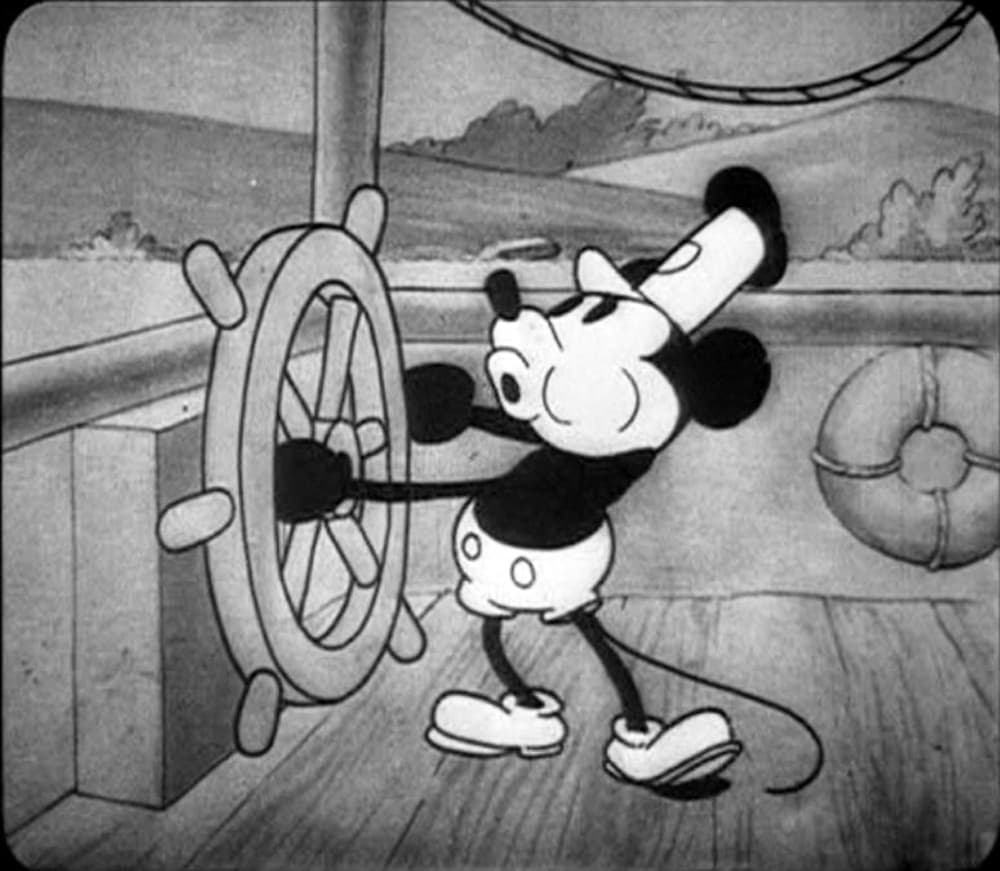
Mickey Mouse is the cartoon mouse who became the face of the Walt Disney Company. He debuted in 1928 in Steamboat Willie, one of the first animated shorts with synchronized sound, piloting a riverboat and improvising music from the animals and cargo aboard. Created by Walt Disney and animator Ub Iwerks, this whistling, mischievous early Mickey looks and behaves quite differently from the polished, friendly character Disney built over the following century.
Why this plate and not another image
Steamboat Willie was published November 18, 1928; its maximum 95-year US term ran out on December 31, 2023 and the film entered the US public domain on January 1, 2024. Commons restored this file for exactly that reason — it sits in Category:Undeleted in 2024. The frame shows the 1928 design that actually cleared: black-and-white, bare hands rather than white gloves, no red shorts. Commons also flags the file {{Trademarked}}, which is the correct warning — Disney’s trademark rights in Mickey are untouched by the copyright expiry.
02 Publication and property history
Walt Disney and Ub Iwerks built Mickey in 1928 after Disney lost control of his previous character, Oswald the Lucky Rabbit, to his distributor — a formative rights dispute that shaped how the studio held on to everything it made afterwards. Plane Crazy and The Gallopin’ Gaucho were produced first as silents; Steamboat Willie, released November 18, 1928, was the one that shipped with synchronized sound and made the character famous.
The 1928 Mickey is visibly a different design from the one most people picture: black-and-white, pie-cut eyes, bare hands instead of white gloves, no red shorts. The gloves arrive in 1929, the color and the softened proportions later, and the modern model sheet is decades of continuous redesign away. Each of those redesigns is its own copyrighted work, which is why the character cannot have one status.
Steamboat Willie’s copyright was registered in 1928, days after release, and renewed — it would have expired in 1955 without renewal, and in 1986 with it. The 1976 Copyright Act pushed the date to 2003; the 1998 Sonny Bono Copyright Term Extension Act, which Disney lobbied for so visibly that it acquired the nickname “the Mickey Mouse Protection Act,” pushed it to the end of 2023. No further extension came, and the film entered the public domain on January 1, 2024.
Disney has used the Steamboat Willie footage as its studio production logo since 2007 — a deliberate move that builds a trademark association in the very version that copyright would eventually release. That is the layer that survives the copyright expiry, and it is the layer most people who read the 2024 headlines missed.
03 Succession of rights holders
Who controlled the rights, and when. The present-day holder is rarely the original one, and the difference is usually where the surviving claims live.
- 1928–1929The Disney Brothers Cartoon Studio / Walt Disney StudioWalt and Roy Disney’s partnership produced and registered the 1928 shorts. Ub Iwerks animated Steamboat Willie almost single-handedly but held no ownership share.
- 1929–1986Walt Disney ProductionsThe incorporated studio held and renewed the copyright, and rebuilt the character continuously — each new design creating a new, separately owned work.
- 1986–presentThe Walt Disney CompanySuccessor entity. Still owns every post-1928 Mickey design, and holds live trademark registrations in Mickey Mouse as a brand identifier — including in the Steamboat Willie imagery it has used as a corporate logo since 2007.
- January 1, 2024 onwardNo copyright owner — 1928 works onlySteamboat Willie and Plane Crazy, and the 1928 character designs as they appear in them, have no US copyright owner. Everything else in the lineage still does.
04 Status determination
Term basis
Published November 18, 1928. Fixed 95-year US term for pre-1978 published works: 1928 + 95 = 2023, so the term ran through December 31, 2023 and the work entered the public domain on January 1, 2024. Registration and renewal were both completed, so no failure-of-formalities shortcut applies — this date is the full term.
Version scope
Only the 1928 designs and the two 1928 films themselves are public domain, effective January 1, 2024. Every later redesign — the color/red-shorts version from 1935 onward, the modern design, the voice — carries its own separate, still-active copyright.
Trademark exposure
High. Disney holds and actively enforces trademarks on Mickey Mouse as a brand identifier, independent of copyright. Using the 1928 footage is free; using Mickey as a logo or mascot is a trademark matter, unaffected by the copyright expiration.
Key case law
No major adjudicated case on the 2024 expiration itself — status is grounded in the fixed 95-year statutory term computed from the 1928 publication date.
05 Legal analysis
This is the clearest example in the catalogue of the specific-version axis. The copyright that expired is the copyright in two 1928 films. It is not a copyright in “Mickey Mouse,” because no such single copyright exists — the character is covered by a long chain of separately copyrighted works, and only the first links in that chain have run out.
Practically, the test is whether the thing you are copying is visible in the 1928 films. Black-and-white, pie eyes, bare hands, rope tail, the boat, the whistling gag: those are in the expired works. White gloves, red shorts, the rounded modern head, the ears that stay circular from any angle, the voice as later recorded, and the personality softened over the 1930s: those come from later works with live copyrights, and copying them is copying a protected work no matter which era you say you were drawing from.
The second, larger exposure is trademark, which runs on entirely different rules. Copyright expires on a schedule; trademark rights last as long as the mark is used and defended, and they protect against consumer confusion about source rather than against copying. Disney’s use of Steamboat Willie in its studio logo since 2007 is the reason this matters specifically here: the 1928 imagery is now also brand identification. Using it as decoration on a product is a copyright question that has been answered; using it as the mark that identifies who made the product is a trademark question that has not.
There is one unresolved detail worth flagging rather than smoothing over: a 1928 promotional poster is reported to show the character with red shorts and gloves, and its own publication status is unclear. Nothing in this determination relies on that poster, and this entry does not treat gloves or red shorts as cleared.
06 What this determination covers
- The films Steamboat Willie and Plane Crazy as published in 1928, under US copyright law.
- The Mickey and Minnie Mouse character designs exactly as they appear in those 1928 films.
- Any Mickey Mouse design, film, short, comic or model sheet created after 1928.
- Disney’s trademark rights, which are live, actively enforced, and unaffected by the copyright expiry.
- Use of the 1928 imagery as a source identifier — a logo, a mascot, or branding — rather than as content.
- Any jurisdiction other than the United States.
07 Sources
- NPR — Steamboat Willie is now in the public domainhttps://www.npr.org/2024/01/01/1221606624/mickey-mouse-public-domain-disney
- NYSBA — Steamboat Willie Enters Public Domainhttps://nysba.org/steamboat-willie-enters-public-domain/
- Wikipedia — Steamboat Willie (registration, renewal, term extensions)https://en.wikipedia.org/wiki/Steamboat_Willie
- Wikimedia Commons — Mickey Mouse, Steamboat Willie (plate)https://commons.wikimedia.org/wiki/File:Mickey_Mouse_-_Steamboat_Willie_(1928).jpg
08 Reviewer note and limits
The demo’s “still layered” case, paired with Sherlock Holmes. The single most important UI moment: explaining in one glance why Mickey isn’t a flat yes — right era of the design, and copyright ≠ trademark.
This dossier is research, not counsel, and OpenGlyph is not a law firm. It states one jurisdiction (United States), one review date (2026-08-10), and one confidence value (High). US public domain dates move every January 1, so a determination that is correct today can be incomplete next year. Verify against primary sources — Copyright Office records and the works themselves — before relying on any of it commercially.
OpenGlyph · Catalogue of the American Public Domain · Entry № 002 · Rev. 2026.08