 Open
OpenTarzan
Complete public domain record. United States jurisdiction only. Compiled from the sources listed in section 07 and reviewed 2026-08-10. Informational — not legal advice.
01 Summary
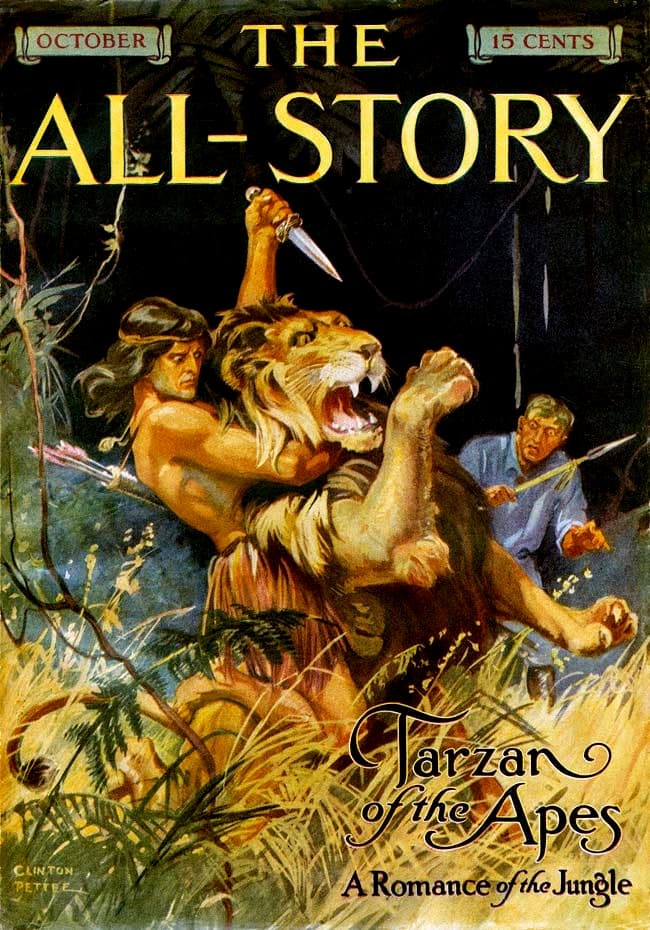
Tarzan is the orphaned son of English aristocrats, raised by apes in the African jungle, created by American author Edgar Rice Burroughs. He first swung into print in the 1912 novel Tarzan of the Apes — pulp adventure fiction that made him an instant sensation — and went on to headline 24 novels plus decades of films, comics, and merchandise across the 20th century.
Why this plate and not another image
First US publication was the October 1912 issue of The All-Story — decades before the January 1, 1931 cutoff, so the US copyright term is long expired regardless of whether it was ever renewed. Chosen deliberately over any later book-edition or film artwork: this is the serialization the status determination is actually about.
02 Publication and property history
Edgar Rice Burroughs sold “Tarzan of the Apes” to The All-Story magazine, which ran it complete in the October 1912 issue under a Clinton Pettee cover. It was his second sale — “Under the Moons of Mars,” the first John Carter story, had run in the same magazine earlier that year. A. C. McClurg published Tarzan of the Apes as a book in 1914 after several publishers turned it down.
Burroughs wrote 24 Tarzan novels between 1912 and the 1940s, and the character escaped the page almost immediately: a newspaper comic strip from 1929, a film series running from 1918 onward, radio, and a merchandising programme that Burroughs ran himself rather than licensing away. That last decision is the one that still shapes the rights picture today.
In 1923 Burroughs incorporated as Edgar Rice Burroughs, Inc. — an unusually early move for an author, done for tax reasons and to keep control of his own works. He bought a ranch outside Los Angeles and named it after the character; the town that grew there is still called Tarzana. Burroughs died in 1950, and the company remains in family ownership, managing and licensing the works and running an active trademark portfolio.
The result is a property where the earliest and most famous works are unambiguously out of US copyright while the name remains a defended trademark, held by a corporate owner with an unbroken hundred-year record of enforcement. That combination is exactly what makes a naive “Tarzan is public domain” answer dangerous.
03 Succession of rights holders
Who controlled the rights, and when. The present-day holder is rarely the original one, and the difference is usually where the surviving claims live.
- 1912–1923Edgar Rice Burroughs (individually)Serial rights sold to The All-Story in 1912; book rights to A. C. McClurg in 1914. Burroughs retained ownership rather than assigning it outright.
- 1923–1950Edgar Rice Burroughs, Inc.Burroughs incorporated in 1923 — one of the first authors to do so — for tax reasons and to keep control over the works and their merchandising.
- 1950–presentEdgar Rice Burroughs, Inc. (Burroughs family ownership)After Burroughs’ death in 1950 the company continued under family ownership. It is headquartered in Tarzana, California, licenses Tarzan and John Carter, and maintains trademark registrations it enforces independently of copyright status.
04 Status determination
Term basis
First published October 1912. Under the fixed US rule for pre-1978 published works, everything published in 1930 or earlier is now out of copyright — the 1912 serial and the 1914 book edition are far past any possible term, renewed or not. The 95-year wall currently stands at 1930 and advances one year each January 1: works from 1931 become free on January 1, 2027. Later novels in the series must be dated individually, and 1929–1963 works additionally require a renewal check.
Version scope
Tarzan of the Apes (1912) and Burroughs’ other pre-1930 novels are public domain under the fixed US date rule. Later novels in the 24-book series require individual verification — not all are confirmed free.
Trademark exposure
High. Edgar Rice Burroughs, Inc. has a long record of using trademark law to restrict use of Tarzan even where the underlying novel is confirmed public domain.
Key case law
ERB Inc. v. Dynamite Entertainment (2012) — sued over Dynamite’s comics based on public-domain Burroughs novels, on trademark/unfair-competition grounds, not copyright. Settled 2014 with a licensing arrangement.
05 Legal analysis
The confidence on this entry is Medium rather than High for one reason: “Tarzan” is not one work. The determination is solid for the 1912 serial and the pre-1930 novels, where the fixed date rule alone settles it. It is not established here for the later books in the 24-novel run, which fall into the 1929–1963 window where US copyright depended on a renewal filed in the 28th year. Establishing those requires checking Copyright Office renewal records title by title, which this entry has not done.
The version-scope consequence is the same shape as Sherlock Holmes: elements that first appear in a later, still-protected novel are not freed by the earlier novels being public domain. Anyone working from “Tarzan is public domain” needs to know which book each element came from.
The larger practical exposure is trademark, and here there is a real litigation record rather than a theoretical risk. Edgar Rice Burroughs, Inc. sued Dynamite Entertainment in 2012 over comics drawn from Burroughs works whose copyrights had expired. The claims were trademark and unfair competition — not copyright, because a copyright claim was not available. The parties settled in 2014 with Dynamite continuing under a licence. Whatever one thinks of the merits, the outcome is instructive: the public domain status of the underlying novel did not prevent a suit, and did not stop it ending in a licence.
So the honest reading is a split. The 1912 text and its original illustration carry no copyright risk. The word “Tarzan” used in a commercial identity carries trademark risk that copyright expiry does nothing to reduce.
06 What this determination covers
- Tarzan of the Apes as published in The All-Story, October 1912, and the 1914 first book edition, under US copyright law.
- Burroughs novels published in 1930 or earlier.
- Clinton Pettee’s October 1912 cover art.
- Burroughs novels published after 1930 — these need an individual date and renewal check that has not been performed here.
- Trademark rights held by Edgar Rice Burroughs, Inc., which have been enforced against public domain source material before.
- Film, television and comic adaptations, each a separate copyrighted work.
- Any jurisdiction other than the United States.
07 Sources
- Wikipedia — Edgar Rice Burroughs, Inc.https://en.wikipedia.org/wiki/Edgar_Rice_Burroughs,_Inc.
- Techdirt — ERB Inc. Using Trademark Law Against Public Domain Storieshttps://www.techdirt.com/articles/20120228/18543417906/edgar-rice-burroughs-inc-using-trademark-law-to-prevent-use-public-domain-stories.shtml
- Wikimedia Commons — The All-Story, October 1912 cover (plate)https://commons.wikimedia.org/wiki/File:Tarzan_All_Story.jpg
08 Reviewer note and limits
The clearest example of trademark used offensively against a confirmed-PD work — a real court fight happened over exactly this tension.
This dossier is research, not counsel, and OpenGlyph is not a law firm. It states one jurisdiction (United States), one review date (2026-08-10), and one confidence value (Medium). US public domain dates move every January 1, so a determination that is correct today can be incomplete next year. Verify against primary sources — Copyright Office records and the works themselves — before relying on any of it commercially.
OpenGlyph · Catalogue of the American Public Domain · Entry № 003 · Rev. 2026.08