Free to use- The novella 'Armageddon 2419 A.D.' (Amazing Stories, August 1928)
- This point is held back from the free entry and appears in full in the character's dossier.
- This point is held back from the free entry and appears in full in the character's dossier.
- This point is held back from the free entry and appears in full in the character's dossier.
Not free to use- 1932–1963 daily/Sunday strip installments — no renewal research located for this range
- This point is held back from the free entry and appears in full in the character's dossier.
- This point is held back from the free entry and appears in full in the character's dossier.
- This point is held back from the free entry and appears in full in the character's dossier.
- This point is held back from the free entry and appears in full in the character's dossier.
- This point is held back from the free entry and appears in full in the character's dossier.
- This point is held back from the free entry and appears in full in the character's dossier.
9 more points on this determination are held back. The full list is in the full dossier →
About
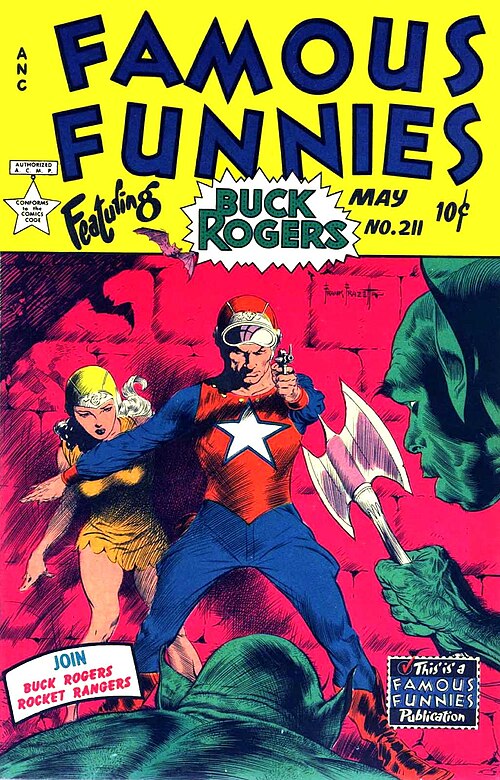
Buck Rogers is a pioneering science-fiction hero who first appeared in 1928 in the novella Armageddon 2419 A.D. by Philip Francis Nowlan, published in Amazing Stories. The story introduced Anthony “Buck” Rogers, a man who falls into a suspended state after being exposed to radioactive gas and awakens nearly 500 years later in a futuristic America.
The character became a cultural phenomenon when the Buck Rogers newspaper comic strip launched in 1929, illustrated by Dick Calkins. It helped establish many of the visual conventions of modern space adventure, featuring rocket ships, ray guns, futuristic cities, and interplanetary battles.
Buck Rogers went on to appear in radio, film serials, television, comic books, toys, and other media, becoming one of the foundational characters of American science fiction and a major influence on later space-adventure heroes.
Version scope
This determination covers only the 1928–1929 print originations (the two Amazing Stories novellas) and, per Duke University's Public Domain Day project, the 1929 comic strip debut and 1931 strips, all reportedly lost to non-renewal under the pre-1978 28-year renewal system. It does NOT extend to later comic strip years, the radio series, Big Little Books, the 1939 film serial or its later re-edits, or the 1979 film/TV series — none of which were confirmed as public domain in the transcript. Two sources disagree on the legal mechanism for the novella (never copyrighted at all, per a blog, vs. copyrighted then lapsed via 1956 non-renewal, per Boing Boing/Wealth Management), and no primary US Copyright Office renewal record was found to resolve this.
Trademark exposure
The US Trademark Office cancelled the Dille Family Trust's 'Buck Rogers' mark and refused a new registration attempt, and the Nowlan Family Trust also lost bids to purge marks it hadn't used commercially, leaving current live trademark ownership unclear.
Key case law
The key case is Team Angry Filmworks, Inc. v. Geer, 214 F. Supp. 3d 432 (W.D. Pa. 2016) — but there is an important caveat: it did not actually rule that Buck Rogers is public domain. The case was dismissed on jurisdiction/justiciability grounds before the court decided the copyright question.
Informational, not legal adviceCurated internally by AE001 This determination is sourced and dated but is not a substitute for legal counsel — verify against primary sources before relying on it commercially.
The complete record: full publication history, the succession of rights holders, the term arithmetic, the expanded legal analysis, and the full source list available by unlocking the full dossier.
 Open