 Open
OpenDracula
Complete public domain record. United States jurisdiction only. Compiled from the sources listed in section 07 and reviewed 2026-08-10. Informational — not legal advice.
01 Summary
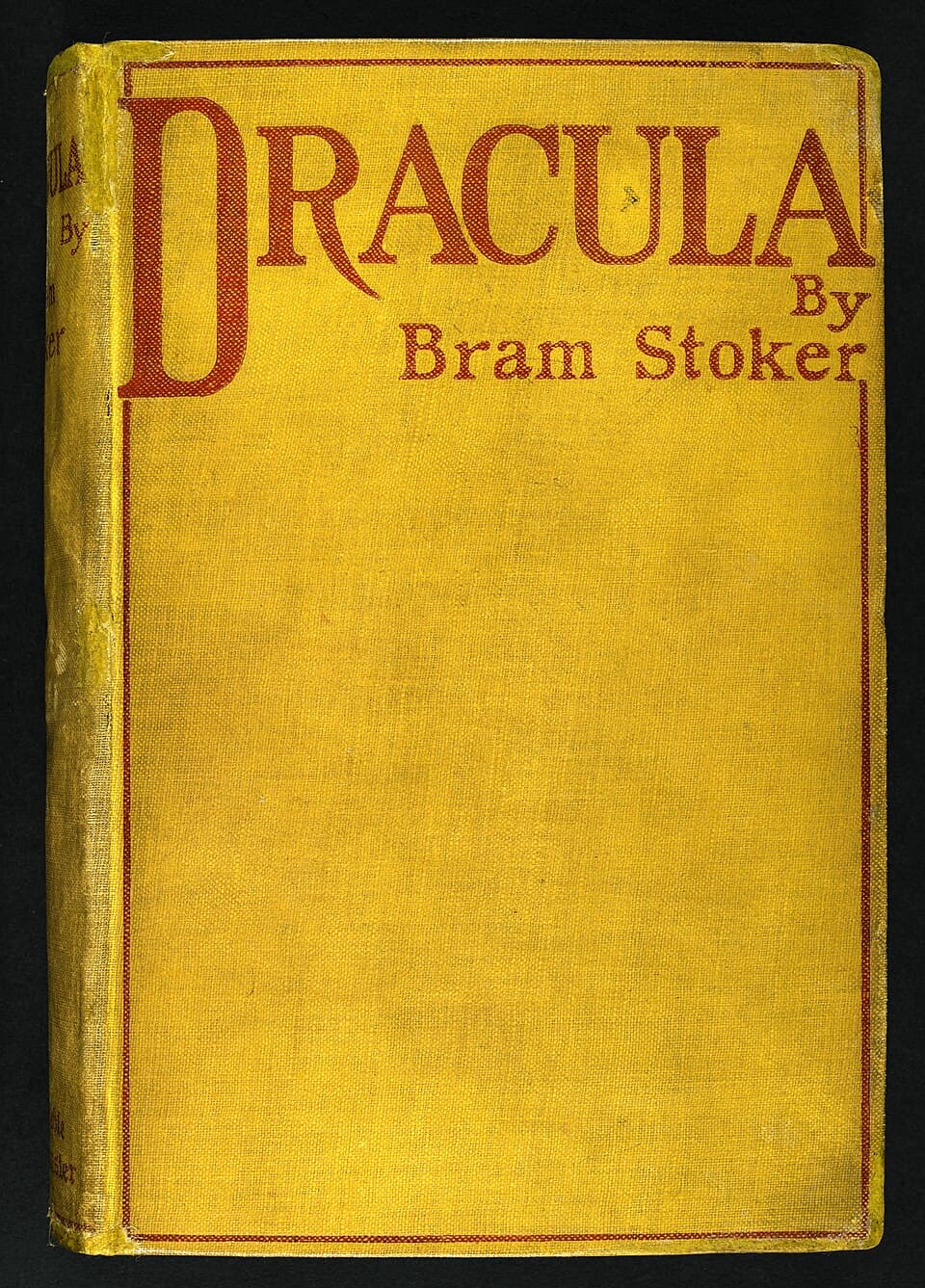
Dracula is the aristocratic vampire of Transylvania created by Irish writer Bram Stoker in his 1897 novel of the same name. Told through letters, diary entries, and newspaper clippings, the book set much of the template modern audiences now expect from vampire fiction. Its Count went on to become one of the most filmed characters in history, starting with Universal’s iconic 1931 version starring Bela Lugosi.
Why this plate and not another image
The 1897 binding is long past any US copyright term, and a faithful photographic reproduction of a flat public domain work generates no new copyright of its own under US law — the reasoning in Bridgeman Art Library v. Corel Corp., 36 F. Supp. 2d 191 (S.D.N.Y. 1999), which is what the {{PD-scan}} tag records. Deliberately avoided: every still, poster and frame from Universal’s 1931 film, which remains under US copyright until January 1, 2027.
02 Publication and property history
Bram Stoker published Dracula through Archibald Constable & Co. in London in 1897, in the mustard-yellow cloth binding shown on this entry’s plate. He had worked on it for years while managing the Lyceum Theatre for Henry Irving, and the epistolary structure — letters, diaries, telegrams, clippings — was a deliberate device to make an impossible story read like assembled evidence.
The book sold steadily rather than spectacularly in Stoker’s lifetime. He died in 1912, and the property’s commercial life really begins with his widow, Florence Balcombe Stoker, who spent the 1920s defending it. When the German studio Prana-Film released Nosferatu in 1922 as an unauthorised adaptation with the names changed, she sued and won, and the court ordered the prints destroyed — one of the most famous copyright enforcement actions in film history, and one that failed only because surviving copies had already escaped.
The stage adaptation by Hamilton Deane (1924), reworked for Broadway by John L. Balderston, is the bridge between the novel and the screen: it introduced the evening-dress, opera-cloak Count that the public now pictures, rather than Stoker’s white-moustached old man. Universal Pictures paid $40,000 for all rights to the novel and the stage plays, and released Tod Browning’s Dracula with Bela Lugosi in 1931.
Everything downstream — the Lugosi performance, the makeup, the accent, the specific staging — belongs to that 1931 film, a separate work with its own term. It enters the US public domain on January 1, 2027, which is why this entry carries a scheduled re-review date rather than a settled answer.
03 Succession of rights holders
Who controlled the rights, and when. The present-day holder is rarely the original one, and the difference is usually where the surviving claims live.
- 1897–1912Bram StokerAuthor and original owner; first published by Archibald Constable & Co., London, 1897.
- 1912–1937Florence Balcombe StokerStoker’s widow held and actively defended the rights — successfully suing Prana-Film over the unauthorised 1922 adaptation Nosferatu, with the court ordering prints destroyed, and licensing the Deane and Balderston stage adaptations in the 1920s.
- 1930–presentUniversal PicturesUniversal paid $40,000 for all rights to the novel and the stage plays, and produced the 1931 film. It owns the 1931 film outright — a separate copyrighted work — and maintains Universal Monsters branding around it.
- NowNo owner of the novelThe 1897 novel has no US copyright owner. Universal still owns the 1931 film until January 1, 2027.
04 Status determination
Term basis
Two works, two clocks. The novel: published 1897, far beyond any US term, public domain without qualification. The film: published 1931, and 1931 + 95 = 2026, so its term runs through December 31, 2026 and it enters the US public domain on January 1, 2027.
Version scope
The 1897 novel — the count, the castle, the plot — is unambiguously public domain. The 1931 Universal film is a separate, later copyrighted work — its specific screen performance and makeup are not yet public domain; it enters US public domain January 1, 2027.
Trademark exposure
Low/moderate. Universal holds broader “Universal Monsters” branding, but “Dracula” itself isn’t gatekept the way Mickey or Zorro are.
Key case law
No major litigation — status is purely a function of the fixed statutory terms for the two separate works.
05 Legal analysis
This entry is the catalogue’s reference case for the specific-version axis, and it is unusually clean because the two works are separated by 34 years and by medium. Nothing about the novel’s status tells you anything about the film’s, and the fact that both are called Dracula is the entire trap.
From the novel you may freely take the Count, Jonathan Harker, Mina, Van Helsing, Renfield, Lucy, the castle, the voyage of the Demeter, the Whitby landing, and Stoker’s text verbatim. From the 1931 film you may take nothing until January 1, 2027 — not the Lugosi performance or likeness, not the makeup and costume as executed on screen, not the specific dialogue written for it, not a frame, a still or a poster.
The Deane/Balderston stage play sits between the two and is worth naming explicitly, because the visual Dracula most people carry in their heads — evening dress, high-collared cape, clean-shaven and continental — comes from the stage and the film, not from Stoker, who described an old man with a heavy white moustache. Someone who believes they are drawing on the public domain novel while actually drawing on the 1931 film’s design has walked past the only line that matters here.
A frequently-repeated claim about this title is that the novel’s US copyright was defective from the start because of a failure to comply with US registration and deposit formalities, which is sometimes offered as the reason Universal negotiated for the stage play rights. This entry does not rely on that argument and does not assert it: the 1897 publication date alone puts the novel out of copyright in the US by an enormous margin, and the outcome is the same either way. [TBD: verify the formalities history against Copyright Office records before repeating it anywhere in product copy.]
06 What this determination covers
- Bram Stoker’s 1897 novel Dracula — its text, plot, characters and settings — under US copyright law.
- The 1897 first edition binding and other pre-1931 printed editions and their illustrations.
- Universal’s 1931 film, which remains under US copyright until January 1, 2027 — including every still, poster, frame and the Lugosi performance and makeup.
- The 1924 Deane and 1927 Balderston stage adaptations as separate works.
- Later films and series in the Universal Monsters line and elsewhere.
- Any jurisdiction other than the United States.
07 Sources
- Wikipedia — Dracula (1931 English-language film)https://en.wikipedia.org/wiki/Dracula_(1931_English-language_film)
- publicdomaincountdown.com — Dracula 1931 filmhttps://publicdomaincountdown.com/public-domain/dracula-1931-film
- Wikimedia Commons — Dracula first edition, 1897 (plate)https://commons.wikimedia.org/wiki/File:Dracula-First-Edition-1897.jpg
08 Reviewer note and limits
The cleanest illustration of “the work vs. this specific version.” Revisit this exact entry on 2027-01-01 — the film’s status flips.
This dossier is research, not counsel, and OpenGlyph is not a law firm. It states one jurisdiction (United States), one review date (2026-08-10), and one confidence value (High). US public domain dates move every January 1, so a determination that is correct today can be incomplete next year. Verify against primary sources — Copyright Office records and the works themselves — before relying on any of it commercially.
OpenGlyph · Catalogue of the American Public Domain · Entry № 004 · Rev. 2026.08