 Open
OpenSherlock Holmes
Complete public domain record. United States jurisdiction only. Compiled from the sources listed in section 07 and reviewed 2026-08-10. Informational — not legal advice.
01 Summary
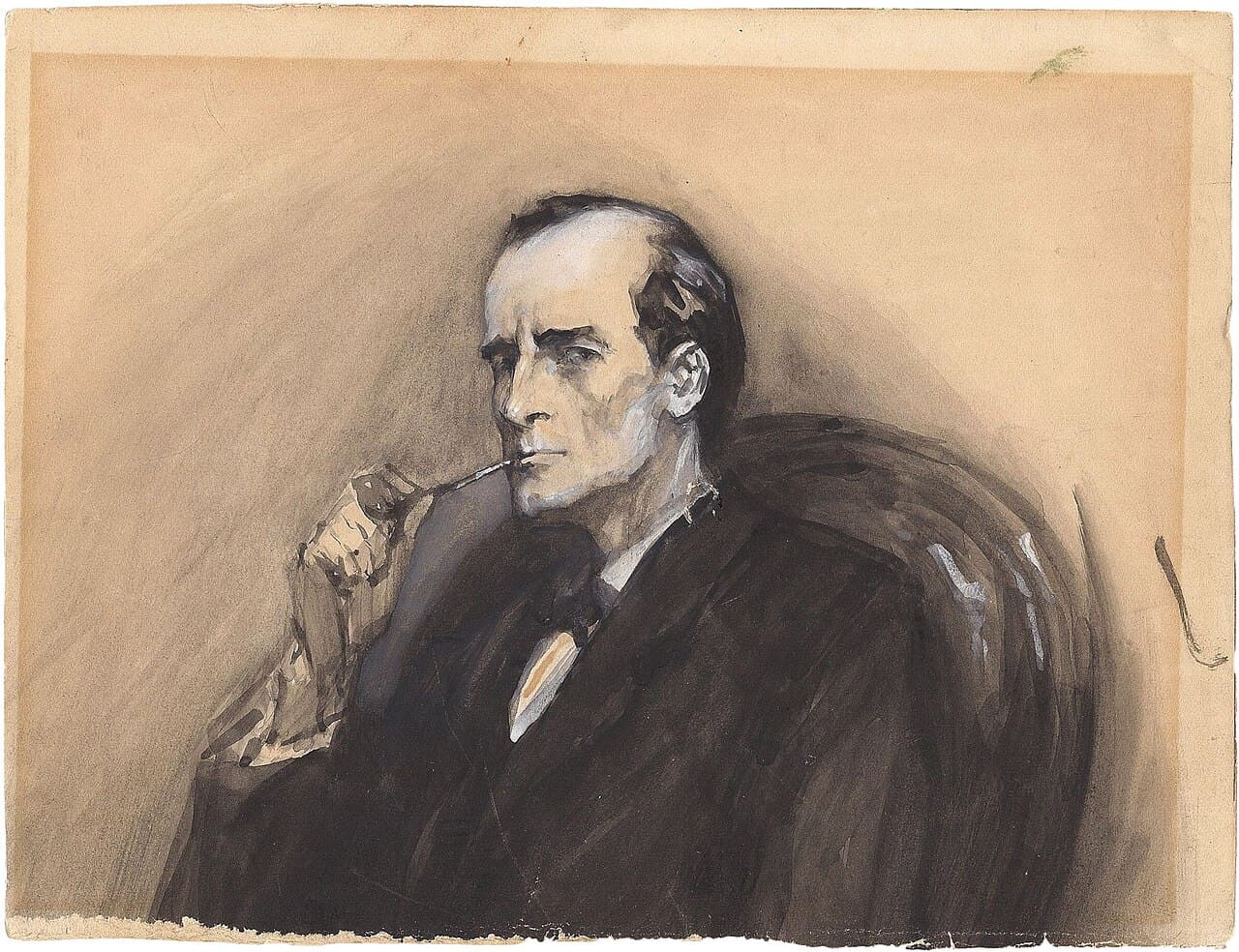
Sherlock Holmes is the world’s most famous fictional detective, created by Scottish author and physician Arthur Conan Doyle. First appearing in the 1887 novel A Study in Scarlet, Holmes solved cases from his flat at 221B Baker Street alongside his friend and chronicler Dr. Watson, using a method of close observation and deduction that became the template for detective fiction ever after. Doyle wrote 56 short stories and four novels about him over four decades, and few literary characters have been reinterpreted on stage and screen as often.
Why this plate and not another image
Commons carries the file under {{PD-old-100-1923}}: the artist died in 1908, more than 100 years ago, and the drawing dates to 1904 — comfortably before the January 1, 1931 cutoff at which US copyright terms for published works have expired. Chosen because Paget’s Strand-era work is the safest visual ground for this character; nothing tied to the late Case-Book stories that only cleared in 2023 was used.
02 Publication and property history
Arthur Conan Doyle introduced Holmes in A Study in Scarlet, published in Beeton’s Christmas Annual in 1887, and followed it with The Sign of the Four in 1890. The character became a mass phenomenon only once the short stories began running monthly in The Strand Magazine from July 1891 — illustrated by Sidney Paget, whose drawings supplied the visual shorthand (the profile, the pipe, the caped ulster) that the text itself never specified.
Doyle killed the character off in “The Final Problem” (Strand, December 1893), was pressed for years to reverse it, published The Hound of the Baskervilles as a retrospective case in 1901–02, and formally revived Holmes in “The Adventure of the Empty House” in 1903. He kept writing him until the final collection, The Case-Book of Sherlock Holmes, in 1927. Doyle died on 7 July 1930, leaving 56 short stories and four novels.
That publication spread — 1887 to 1927, forty years — is the whole reason this entry needed a version-aware answer for so long. The bulk of the canon fell out of US copyright decades ago, while the last ten stories kept running out their terms one calendar year at a time until 2023. During that gap the estate’s licensing business rested almost entirely on the tail end of the canon.
03 Succession of rights holders
Who controlled the rights, and when. The present-day holder is rarely the original one, and the difference is usually where the surviving claims live.
- 1887–1930Arthur Conan DoyleAuthor and original copyright owner across the full canon.
- 1930–1940Jean, Lady Conan DoyleDoyle’s second wife held the estate after his death in 1930.
- 1940–1970Denis, Adrian and Dame Jean Conan DoyleThe three children inherited the copyrights when their mother died in 1940. Denis handled screen licensing (the Basil Rathbone films, a 1954 television series) until his death in 1955.
- 1970sBaskervilles Investments LtdDenis’s widow, Princess Nina Mdivani, bought the estate in 1970 with a loan from the Royal Bank of Scotland and placed it in this company. Adrian died the same year.
- 1970–1997Dame Jean Conan DoyleDoyle’s last surviving child became literary executor and held US copyright in the remaining works; in 1981 she registered the copyright in The Case-Book of Sherlock Holmes.
- PresentConan Doyle Estate LtdThe family-linked entity that litigated Klinger (2013–14) and sued Netflix in 2020 over Enola Holmes. It holds no remaining US copyright in the canon — its position now rests on trademark and licensing goodwill, not copyright.
04 Status determination
Term basis
Pre-1978 published works get a fixed maximum US term of 95 years from publication (17 U.S.C. § 304, as extended by the 1998 Copyright Term Extension Act). The last-published Doyle stories appeared in 1927: 1927 + 95 = 2022, so the term ran through December 31, 2022 and the work entered the public domain on January 1, 2023.
Version scope
No caveat remains. As of January 1, 2023, the last Doyle stories (from The Case-Book of Sherlock Holmes, 1921–1927) cleared the 95-year US term. Before that date this was genuinely unsettled.
Trademark exposure
None significant. No single rights holder controls “Sherlock Holmes” as a brand.
Key case law
Klinger v. Conan Doyle Estate, Ltd., 755 F.3d 496 (7th Cir. 2014) — rejected the Estate’s theory that traits introduced in still-copyrighted late stories extended protection to the character himself.
05 Legal analysis
The status turns on a fixed date, not on when Doyle died. US law for pre-1978 published works ignores the author’s lifespan entirely and counts from first publication, which is why an author who died in 1930 can have works that stayed protected in the US until 2023 — while the same works became free in life-plus-70 countries decades earlier. This determination covers the United States only.
The hard question was never the stories; it was the character. In Klinger v. Conan Doyle Estate the Estate argued that Holmes was a “round” or still-developing character, so that traits introduced in the ten stories still under copyright extended protection over the character as a whole. Leslie Klinger sought a declaratory judgment; the Northern District of Illinois ruled for him in December 2013 and the Seventh Circuit affirmed in June 2014 (755 F.3d 496). The rule that came out of it is the one this catalogue uses generally: elements first introduced in a still-copyrighted story stay protected, but a character established in public domain stories is free to use in the form those stories established.
A follow-on ruling awarded Klinger his attorney’s fees, with the Seventh Circuit criticising the Estate’s practice of collecting licence fees from users who would rather pay than litigate. That is the practical mechanism this product exists to disarm — the cost of uncertainty, not the merits.
As of January 1, 2023 the analysis collapses to a single line: no Doyle work in the canon retains a US copyright, so there is no version-dependence left. What survives is ordinary trademark exposure on specific marks and logos used by specific licensors — a separate legal regime that copyright expiry does not touch.
06 What this determination covers
- The 56 short stories and 4 novels by Arthur Conan Doyle, published 1887–1927, under United States copyright law.
- The characters, plots and text as established in those works.
- Sidney Paget’s Strand-era illustrations, published in the same window.
- Any jurisdiction other than the United States.
- Later adaptations — films, series, translations, annotated editions — each of which carries its own separate copyright.
- Trademarks and logos used by present-day licensors, which are unaffected by copyright expiry.
07 Sources
- Klinger v. Conan Doyle Estate, Ltd. — Stanford Fair Usehttps://fairuse.stanford.edu/case/klinger-v-conan-doyle-estate-ltd
- CBR — The Last Sherlock Holmes Story Hits Public Domainhttps://www.cbr.com/last-sherlock-holmes-story-finally-hits-public-domain/
- Wikipedia — Jean Conan Doyle (estate succession)https://en.wikipedia.org/wiki/Jean_Conan_Doyle
- Variety — Conan Doyle Estate sues Netflix over Enola Holmes (2020)https://variety.com/2020/biz/news/sherlock-holmes-netflix-copyright-enola-holmes-lawsuit-1234648188/
- Wikimedia Commons — Portrait of Sherlock Holmes by Sidney Paget (plate)https://commons.wikimedia.org/wiki/File:Portrait_of_Sherlock_Holmes_by_Sidney_Paget.jpg
08 Reviewer note and limits
The demo’s “resolved” case — illustrates why version-by-version reasoning mattered for nearly a decade, and what fully cleared looks like once the calendar catches up.
This dossier is research, not counsel, and OpenGlyph is not a law firm. It states one jurisdiction (United States), one review date (2026-08-10), and one confidence value (High). US public domain dates move every January 1, so a determination that is correct today can be incomplete next year. Verify against primary sources — Copyright Office records and the works themselves — before relying on any of it commercially.
OpenGlyph · Catalogue of the American Public Domain · Entry № 001 · Rev. 2026.08