 Open
OpenWinnie-the-Pooh
Complete public domain record. United States jurisdiction only. Compiled from the sources listed in section 07 and reviewed 2026-08-10. Informational — not legal advice.
01 Summary
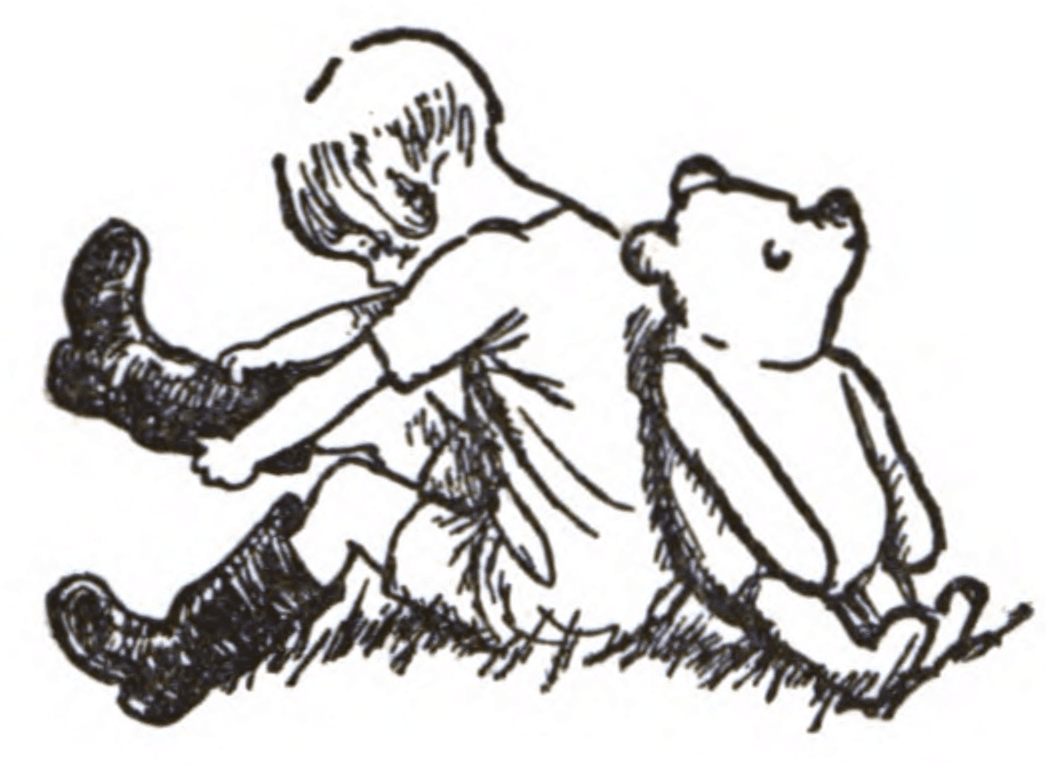
Winnie-the-Pooh is the gentle, honey-loving bear at the center of A. A. Milne’s Hundred Acre Wood, inspired by a real teddy bear owned by Milne’s son, Christopher Robin. Introduced in the 1926 book Winnie-the-Pooh and illustrated by E. H. Shepard, Pooh and his friends — Piglet, Eeyore, Owl, Kanga, Roo, and later Tigger — became one of the best-loved casts in children’s literature and one of Disney’s most enduring licensed properties.
Why this plate and not another image
The 1926 book was published simultaneously in the United Kingdom and the United States, so it carries a US term of 95 years from 1926: expired December 31, 2021, public domain from January 1, 2022. This is Shepard’s original 1926 line art, the version that actually cleared. Deliberately avoided: any Disney-designed Pooh, which is a separate and still-protected design lineage and is exactly the trap this catalogue exists to catch.
02 Publication and property history
A. A. Milne built the stories around his son Christopher Robin’s real toys — a teddy bear, a piglet, a donkey, a kangaroo and joey — and E. H. Shepard drew them from the toys themselves rather than inventing designs. Winnie-the-Pooh was published in 1926, simultaneously in London by Methuen and in New York by E. P. Dutton, and The House at Pooh Corner followed in 1928, introducing Tigger.
The commercial history starts almost immediately. On January 6, 1930, Milne sold US and Canadian merchandising, television, recording and other trade rights to the American licensing agent Stephen Slesinger for a $1,000 advance and 66% of Slesinger’s income from them. Within two years the character was reported as a $50 million-a-year business — one of the earliest examples of a literary property built into a merchandising machine.
Slesinger died in 1953 and his widow, Shirley Slesinger Lasswell, continued the business. In 1961 she licensed rights to Walt Disney Productions in exchange for royalties, in the first of two agreements between Stephen Slesinger, Inc. and Disney; in the same year Milne’s widow Daphne licensed motion picture rights to Disney directly. Disney’s own Pooh — redrawn, recoloured, red-shirted — dates from that arrangement and is a separate creative lineage from Shepard’s.
Decades of litigation between the Slesinger family and Disney followed over royalty accounting and the scope of the grants, with a 2009 federal ruling finding that the Slesinger family had granted its trademarks and copyrights to Disney while Disney remained obliged to pay royalties for future use. None of that touched the underlying Milne copyright terms, which simply ran out on schedule: the 1926 book on January 1, 2022, the 1928 sequel on January 1, 2024.
03 Succession of rights holders
Who controlled the rights, and when. The present-day holder is rarely the original one, and the difference is usually where the surviving claims live.
- 1926–1956A. A. Milne (text) and E. H. Shepard (illustrations)Original authors and owners. Milne died in 1956; Shepard, who outlived him by twenty years, died in 1976.
- 1930–1953Stephen Slesinger (merchandising rights)Bought US and Canadian merchandising, television, recording and trade rights from Milne on January 6, 1930 for a $1,000 advance plus 66% of income. Copyright in the books stayed with Milne.
- 1953–1961Shirley Slesinger Lasswell / Stephen Slesinger, Inc.Slesinger’s widow ran the licensing business after his death in 1953.
- 1961–presentWalt Disney Productions / The Walt Disney CompanyLicensed from Stephen Slesinger, Inc. in 1961, and separately from Daphne Milne for motion picture rights the same year. Long-running litigation with the Slesinger family ended with a 2009 ruling that the trademarks and copyrights had been granted to Disney subject to continuing royalties. Disney owns its own Pooh designs and holds trademarks around them.
- January 1, 2022 / January 1, 2024No copyright owner — Milne and Shepard works onlyThe 1926 book cleared on January 1, 2022 and the 1928 sequel on January 1, 2024. Disney’s own designs and trademarks are unaffected.
04 Status determination
Term basis
Two books, two dates. Winnie-the-Pooh: published 1926, 1926 + 95 = 2021, term ran through December 31, 2021, public domain January 1, 2022. The House at Pooh Corner: published 1928, 1928 + 95 = 2023, term ran through December 31, 2023, public domain January 1, 2024 — which is the date that governs Tigger, who first appears there.
Version scope
Pooh, Piglet, Rabbit, Eeyore, Kanga, Roo, and Owl entered US public domain January 1, 2022. Tigger is NOT included — introduced in the 1928 sequel, his date is January 1, 2024, two years later than the rest of the cast.
Trademark exposure
High. Disney holds trademarks tied to its own licensed character designs, unaffected by the Milne text/illustrations entering the public domain.
Key case law
No major litigation. The 2022 clearance produced Winnie-the-Pooh: Blood and Honey (2023) as a widely publicized test of what the status actually permits.
05 Legal analysis
This entry is the catalogue’s reference case for the fact that a public domain date attaches to a work, not to a franchise or a cast. Pooh, Piglet, Eeyore, Rabbit, Owl, Kanga and Roo all appear in the 1926 book and were free from January 1, 2022. Tigger does not appear until The House at Pooh Corner in 1928 and was not free until January 1, 2024. For two years the correct answer to “is Winnie-the-Pooh public domain?” was “most of them.”
The second distinction is between design lineages. What entered the public domain is Milne’s text and Shepard’s original line drawings. Disney’s Pooh — the rounded, red-shirted, differently-proportioned version created from 1961 onwards — is a separate body of copyrighted work, and it is the version most people actually have in mind. Copying that version is copying a live copyright even though the underlying character is free, which makes this the single easiest way to get the answer wrong in a way that costs money.
Trademark sits on top of both. Disney holds registrations tied to its own designs and to the property as a brand, and those are unaffected by the copyright expiry — the same copyright-versus-trademark split as Mickey Mouse, and for the same reason.
The 2022 clearance was tested publicly and quickly: Winnie-the-Pooh: Blood and Honey (2023) was produced specifically on the strength of the public domain status, working from the Milne/Shepard material and staying away from Disney’s designs. It is a useful marker of where the line was understood to fall, though it is a production decision rather than a court ruling and should not be cited as one.
06 What this determination covers
- Winnie-the-Pooh (1926) — Milne’s text and Shepard’s illustrations — under US copyright law, from January 1, 2022.
- The House at Pooh Corner (1928), including Tigger, from January 1, 2024.
- The characters as depicted and described in those two books.
- Disney’s Pooh character designs, created from 1961 onwards, which remain under copyright.
- Disney trademarks covering the property and its designs.
- Milne’s and Shepard’s other works, and any later adaptation, each with its own term.
- Any jurisdiction other than the United States. UK copyright in Milne’s work runs on a life-plus-70 clock, not this one.
07 Sources
- NPR — Winnie the Pooh enters the public domainhttps://www.npr.org/2021/12/31/1069434896/winnie-the-pooh-and-more-works-will-enter-the-public-domain-tomorrow
- FindLaw — Can I Use the Winnie the Pooh Characters?https://www.findlaw.com/legalblogs/law-and-life/can-i-use-the-winnie-the-pooh-characters-to-make-my-own-stuff/
- Wikipedia — Winnie-the-Pooh (Slesinger and Disney rights history)https://en.wikipedia.org/wiki/Winnie-the-Pooh
- Wikimedia Commons — E. H. Shepard illustration, Winnie-the-Pooh 1926 (plate)https://commons.wikimedia.org/wiki/File:Winnie-the-Pooh_07.png
08 Reviewer note and limits
Good “ensemble” example — a public-domain date applies per-character, not per-franchise. Tigger’s 2-year lag is the detail naive sources miss.
This dossier is research, not counsel, and OpenGlyph is not a law firm. It states one jurisdiction (United States), one review date (2026-08-10), and one confidence value (High). US public domain dates move every January 1, so a determination that is correct today can be incomplete next year. Verify against primary sources — Copyright Office records and the works themselves — before relying on any of it commercially.
OpenGlyph · Catalogue of the American Public Domain · Entry № 006 · Rev. 2026.08