 Open
OpenZorro
Complete public domain record. United States jurisdiction only. Compiled from the sources listed in section 07 and reviewed 2026-08-10. Informational — not legal advice.
01 Summary
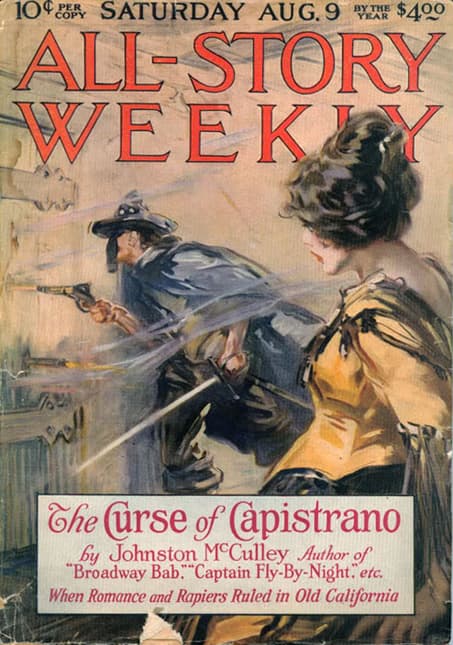
Zorro is the masked swordsman who defends the people of Spanish California by night while posing as a bored nobleman, Don Diego de la Vega, by day. Created by American pulp writer Johnston McCulley, he first appeared in the 1919 serial The Curse of Capistrano and quickly became a template for the modern masked hero — Douglas Fairbanks’ 1920 film The Mark of Zorro is often cited as an influence on later characters like Batman.
Why this plate and not another image
Published August 9, 1919 in the United States, well before the January 1, 1931 cutoff, so the US copyright term is expired. The cover artist P. J. Monahan died in 1931, which also clears it in the source country under a life-plus-70 rule. This is the first appearance of the character in print — the same publication the status determination rests on.
02 Publication and property history
Johnston McCulley’s “The Curse of Capistrano” ran as a five-part serial in All-Story Weekly from August 9 to September 6, 1919, under a P. J. Monahan cover. It introduced the whole apparatus later masked heroes borrowed: the wealthy idler as public identity, the masked avenger as private one, the carved signature mark, the loyal mute servant, the secret passage under the family hacienda.
Douglas Fairbanks adapted it as The Mark of Zorro in 1920, and the film — not the pulp serial — is what made the character permanent. McCulley kept writing Zorro stories for the next four decades while the character passed through film serials, a Disney television series in the 1950s, and a long run of international adaptations.
The chain of ownership matters more here than the writing does. McCulley assigned his Zorro rights to the agent Mitchell Gertz in 1949, nine years before his own death. Gertz died in 1961 and the rights passed into his estate; his children built that inheritance into Zorro Productions, Inc., which has licensed the character worldwide ever since and holds a large trademark portfolio around the name.
That portfolio is why this entry is a “Public domain” badge with a warning attached. The copyright question has been answered more than once by federal courts. The commercial question has not been settled by those answers, because it is being fought on trademark ground instead.
03 Succession of rights holders
Who controlled the rights, and when. The present-day holder is rarely the original one, and the difference is usually where the surviving claims live.
- 1919–1949Johnston McCulleyAuthor and original copyright owner. First publication in All-Story Weekly, August 9, 1919; more than sixty Zorro stories followed.
- 1949–1961Mitchell GertzMcCulley assigned his Zorro rights to the agent Mitchell Gertz in 1949 — the assignment that every later ownership claim traces back to.
- 1961–1970sEstate of Mitchell GertzGertz died in 1961 and the rights passed to his children.
- 1970s–presentZorro Productions, Inc.Established by the Gertz children to manage the property. Its remaining leverage is trademark and licensing rather than copyright — courts have repeatedly held the underlying story to be in the public domain.
04 Status determination
Term basis
Published August 9, 1919. Under the pre-1998 US regime the maximum term was 28 years plus a 28-year renewal — 56 years, expiring in 1975 — and the 1998 Copyright Term Extension Act did not revive works whose terms had already run out. The result is confirmed twice over by the current fixed rule: anything published in 1930 or earlier is now public domain in the US regardless of the route it took to get there.
Version scope
The original 1919 story and its core elements are public domain — McCulley’s copyright expired in 1975 under the pre-1998 term rules and was never revived. No copyright-side caveat remains.
Trademark exposure
High. Zorro Productions, Inc. holds an extensive, actively defended trademark portfolio and has a documented history of asserting it against works based on the public-domain story.
Key case law
Federal court ruling, May 11, 2018 — held Zorro is in the public domain and a rival stage musical did not infringe any rights held by Zorro Productions, Inc.
05 Legal analysis
Two independent lines of reasoning reach the same conclusion, which is why confidence here is High. The term arithmetic settles it on its own: a 1919 publication expired in 1975 at the latest, and the 1998 extension was prospective — it lengthened live terms and did not restore expired ones. Separately, the current fixed date rule puts everything published through 1930 in the public domain, and 1919 is inside that window by a wide margin.
Courts have said so directly. In Sony Pictures Entertainment v. Fireworks Entertainment Group (2001) the court found that because the copyrights in The Curse of Capistrano and The Mark of Zorro had lapsed by 1995 at the latest, the character Zorro had been in the public domain since then. The point was reached again in the Robert Cabell litigation over “Z — The Musical of Zorro,” filed in 2013, in which a federal court held in 2018 that Zorro is in the public domain and that the rival musical did not infringe rights held by Zorro Productions, Inc.
What Cabell did not win is as instructive as what he did. His separate claim to cancel Zorro Productions’ federal trademark registrations was dismissed in May 2017 and he did not appeal. So the registrations survived the case that voided the copyright theory — which is precisely the split this catalogue keeps insisting on. The story is free. The name, as a commercial identifier in the classes where it is registered, is not free in the same sense.
The practical reading: reproducing, adapting, republishing or performing the 1919 text and the pre-1930 material carries no US copyright risk. Selling goods or entertainment under “Zorro” as a brand puts you in front of a rights holder with a long enforcement record and live registrations, and a public domain finding on the copyright side does not resolve that.
06 What this determination covers
- The Curse of Capistrano as serialised in All-Story Weekly, August 9 – September 6, 1919, under US copyright law.
- The 1920 Douglas Fairbanks film The Mark of Zorro, whose copyright also lapsed.
- P. J. Monahan’s 1919 cover art.
- Zorro Productions, Inc.’s federal trademark registrations, which survived the Cabell litigation and are actively enforced.
- Later McCulley stories, film serials, the 1950s Disney television series and other adaptations, each with its own term to check.
- Any jurisdiction other than the United States.
07 Sources
- Courthouse News — No One Owns ‘Zorro,’ Playwright Sayshttps://www.courthousenews.com/no-one-owns-zorro-playwright-says/
- Nova Law — Will the ‘Mark’ of Zorro Defeat Public Domain Ruling?https://copyright.nova.edu/zorro/
- Wikipedia — Zorro (rights history, Gertz assignment, Sony v. Fireworks)https://en.wikipedia.org/wiki/Zorro
- Wikimedia Commons — All-Story Weekly, August 9, 1919 cover (plate)https://commons.wikimedia.org/wiki/File:Capistrano2.jpg
08 Reviewer note and limits
Important vocabulary edge case: “Public domain” (copyright) and “safe to use commercially” are not the same claim. The trademark field carries real weight even though the status badge reads clean.
This dossier is research, not counsel, and OpenGlyph is not a law firm. It states one jurisdiction (United States), one review date (2026-08-10), and one confidence value (High). US public domain dates move every January 1, so a determination that is correct today can be incomplete next year. Verify against primary sources — Copyright Office records and the works themselves — before relying on any of it commercially.
OpenGlyph · Catalogue of the American Public Domain · Entry № 005 · Rev. 2026.08