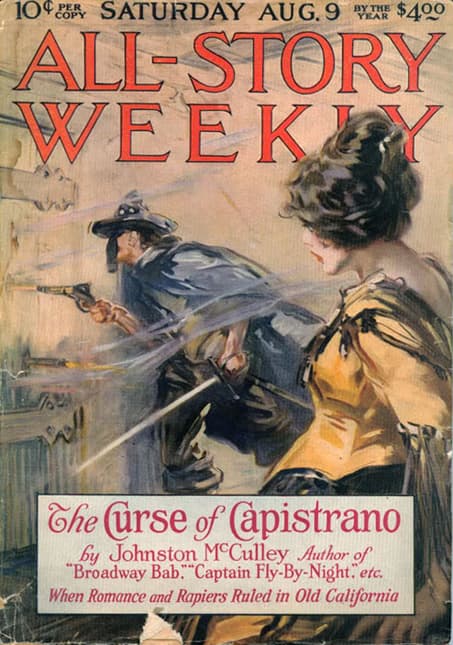
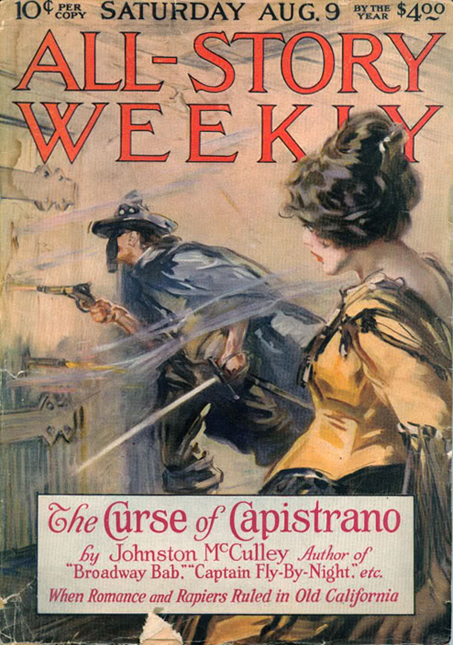
Free to use- The Curse of Capistrano as serialised in All-Story Weekly, August 9 – September 6, 1919, under US copyright law.
- The 1920 Douglas Fairbanks film The Mark of Zorro, whose copyright also lapsed.
- P. J. Monahan’s 1919 cover art.
Not free to use- Zorro Productions, Inc.’s federal trademark registrations, which survived the Cabell litigation and are actively enforced.
- Later McCulley stories, film serials, the 1950s Disney television series and other adaptations, each with its own term to check.
- Any jurisdiction other than the United States.
About
Zorro is the masked swordsman who defends the people of Spanish California by night while posing as a bored nobleman, Don Diego de la Vega, by day. Created by American pulp writer Johnston McCulley, he first appeared in the 1919 serial The Curse of Capistrano and quickly became a template for the modern masked hero — Douglas Fairbanks’ 1920 film The Mark of Zorro is often cited as an influence on later characters like Batman.
Version scope
The original 1919 story and its core elements are public domain — McCulley’s copyright expired in 1975 under the pre-1998 term rules and was never revived. No copyright-side caveat remains.
Trademark exposure
High. Zorro Productions, Inc. holds an extensive, actively defended trademark portfolio and has a documented history of asserting it against works based on the public-domain story.
Key case law
Federal court ruling, May 11, 2018 — held Zorro is in the public domain and a rival stage musical did not infringe any rights held by Zorro Productions, Inc.
Informational, not legal adviceImportant vocabulary edge case: “Public domain” (copyright) and “safe to use commercially” are not the same claim. The trademark field carries real weight even though the status badge reads clean. This determination is sourced and dated but is not a substitute for legal counsel — verify against primary sources before relying on it commercially.
The complete record: full publication history, the succession of rights holders, the term arithmetic, the expanded legal analysis, and the full source list — already compiled and reviewed, just held back from this page by default.
 Open
Open